

What happened in Cape Town this week
By Martha Dark, Co-Director, Foxglove
This week, in Cape Town, South Africa, lawyers acting for Foxglove and the Housing Assembly[1] – a social movement representing more than 20 local communities – stood up in front of the city’s planning tribunal to object to a massive new hyperscale data centre.
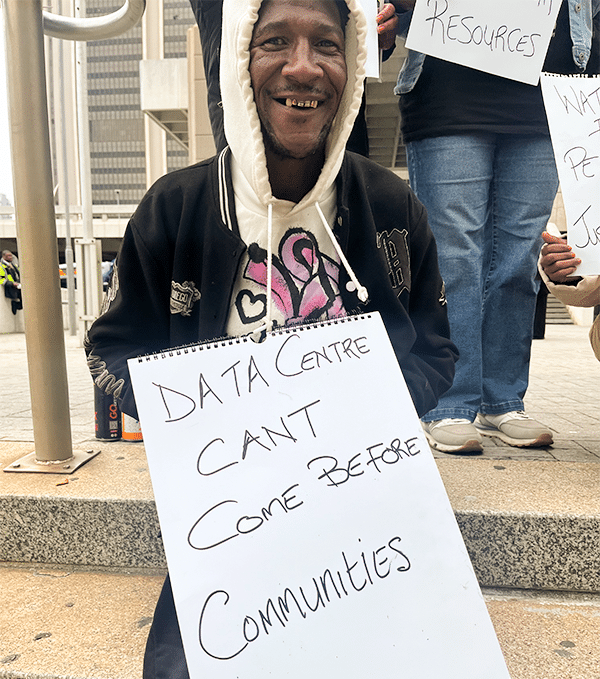
While the lawyers made their case inside, Housing Assembly members demonstrated outside the Civic Centre.
Here’s what this fight is about.
Equinix, a US-based multinational that runs more than 260 data centres around the world, wants to build a huge new data centre facility on the edge of Cape Town.
These facilities are power and water-guzzling monsters that can emit carbon pollution equivalent to an international airport. But instead of a serious, comprehensive application, Equinix has asked the city to change the land permissions on the basis of a motivational letter that says, as our formal objection[2] put it:
“nothing about water, nothing about emissions, limited on electricity, nothing about diesel generators, nothing about air pollution, nothing about noise – and provides no plans for the buildings themselves.”
The silence on water matters most of all in a city that knows what water scarcity means.
With the 2017/18 “Day Zero” crisis, in which Housing Assembly members literally watched their taps run dry, still surely fresh in the minds of tribunal members, our legal team highlighted that just a 1MW traditionally cooled data centre can use up an estimated 25.5 million litres of water a year.
The facility in question will sit just across the highway from the Barcelona and KTC neighbourhoods of Gugulethu township, where many Housing Assembly members live. These are communities relying on free-standing taps and pre-paid electricity boxes. They have fought struggles for decades to get decent housing, water and power. Those struggles could all be set back if this data centre gets switched on.
Our lawyers at the Legal Resources Centre[3] asked the tribunal to do something simple: reject the application, and make the developers come back with a fresh one that’s honest about what they’re building and what its impact will be. No community should be asked to sign off on a project this big with this little information.
However, with just one exception, the tribunal gave the go-ahead.
This is the Big Tech playbook we have seen again and again: turn up in a community, tell them as little as possible about the huge harm a data centre will cause, and leave the people living there to pick up the pieces.
The simple fact is that data centres use huge quantities of resources across the globe and there is no evidence to suggest that South Africa will be any different.
“The Municipal Planning Tribunal, bar one, failed the people of Cape Town today by prioritising business interests over the people,” said Sherylle Dass of LRC after the decision was handed down on Tuesday.
But that one dissenting member, Wally Johnstone, made sure to use his voice in the tribunal to highlight problems in Cape Town around access to electricity, the wider context of climate change, and the developer’s failure to provide information on water use, warning that the objection “should not be ignored.”
“Capetonians and South Africans as a whole have experienced load shedding and regular outages for an extended period of time,” he emphasised. “The public has a right to know how this approval will affect grid stability and access to electricity.”
We agree. That’s why we’ll keep fighting to ensure that Housing Assembly’s members and the people of Cape Town are not left with the huge environmental and social costs that come with Big Tech’s data centres.
This work, alongside Housing Assembly in Cape Town, is part of one global fight – and we know we can win against governments and Big Tech giants alike.
In January of this year, a Foxglove legal case forced the UK government to U-turn on its plan to push through a hyperscale data centre without proper environmental scrutiny, and set a brand new precedent for hyperscale data centres – that environmental protections claimed by developers must be legally binding, not just empty promises.[4]
Then in February, Edinburgh councillors unanimously rejected plans for a huge new AI data centre in South Gyle, after a big campaign including hard-hitting research from Foxglove on its environmental impact, and thousands of messages from our supporters to local councillors.
Back in Cape Town, we are now reviewing the tribunal’s decision with our lawyers at LRC, and taking advice on our next legal steps.
More to come soon.
_____________
[1] The Housing Assembly represents people living in informal settlements, backyard dwellings and inadequately built RDP housing across more than 20 communities in the Western Cape – people who’ve spent decades fighting for water, electricity and decent homes. We’re proud to be standing shoulder to shoulder with them. You can read more about them here: https://housingassembly.org.za/
[2] Foxglove and Housing Assembly’s objection to the Equinix data centre (April 2026): https://www.foxglove.org.uk/2026/04/29/foxglove-south-african-housing-movement-challenge-new-hyperscale-data-centre/
[3] The brilliant lawyers working with Foxglove and Housing Assembly in this case are The Legal Resources Centre (LRC), an independent, non-profit public interest law centre with offices throughout South Africa. They aim to empower individuals and communities through the law, promoting social justice, championing equality, and realizing the human rights enshrined in the South African Constitution. More on them here: https://lrc.org.za/
[4] The Guardian on Foxglove’s UK data centre win (January 2026): https://www.theguardian.com/politics/2026/jan/22/government-ai-datacentre-approval-quashed